view counter

Regulars (Sky Watch by J. Alex Knoll)

Let its waxing glow guide you

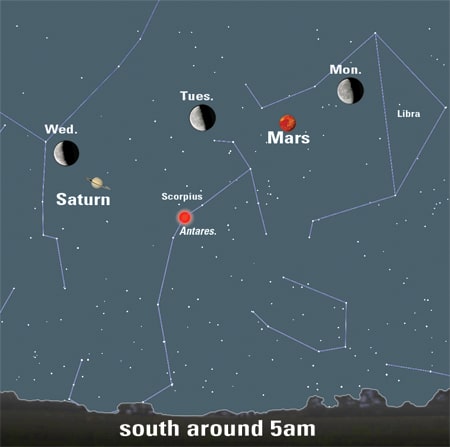
The moon reappears in our evening skies Thursday as a thin crescent low in the southwest at dusk. Lined up to the west is the twinkling blue-white star Spica and beyond that golden Saturn.     Friday the moon is just a few degrees below the second-magnitude star Zubenelgenubi, the fulcrum of the celestial scale Libra. Saturday the moon stands before Scorpius, with its red heart Antares trailing less than 10 degrees from the moon. The next evening, it is the red star that leads...

More than stars and planets brighten our night skies

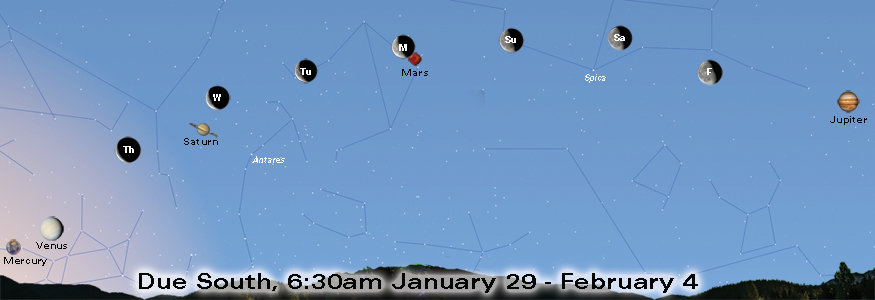
The moon wanes through week’s end, reaching new phase Sunday. Friday the thin crescent rises around 4am, trailing a dozen degrees behind the Gemini twins Castor and Pollux to slightly to the north and ruddy Mars a little to the south.     Saturday, the last sliver of moon rises at 5am. Mars is far to the west, while between the moon and the horizon is the bright glow of Mercury. You should have no trouble spotting Mars, but you may need binoculars to isolate Mercury and...

When the Dog Star rises, so does the heat

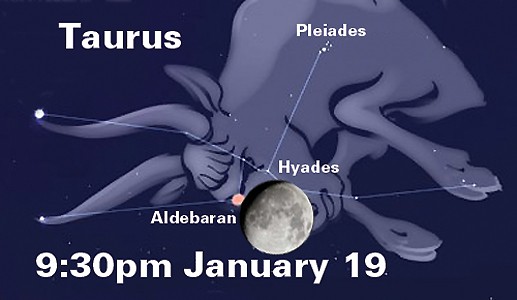
The waning moon rises around 10:30pm at week’s end Friday, with the bright glow of Jupiter trailing just a few degrees behind. By Sunday, the last-quarter moon rises a little before midnight just below the speckling lights of the Pleiades star cluster, which mark the back of Taurus. Ten degrees beneath the moon glares the bull’s red eye, the star Aldebaran, and midway between the two, outlining Taurus’ V-shaped face, are the stars of the Hyades cluster.     The...

The near-full moon bleaches out all but the brightest of this year’s Perseid meteor shower

The moon waxes to full Saturday, rising between the dim water constellations Aquarius and Capricornus. August’s full moon is named the Green Corn Moon, the Grain Moon and the Sturgeon Moon, for the great fish that once filled our waterways.     That same moon, alas, bleaches out all but the brightest bursts from this year’s Perseid meteor shower, which peaks late Friday. Still, away from city lights between midnight and dawn, don’t be surprised if you see an...

Gazing at the Andromeda Galaxy, we look through space and time

Of all the lights in the heavens, one stands alone. Looking at the night sky, we stare at a family of stars all akin to our own, all a part of the Milky Way Galaxy. However, nestled within the stars of the constellation Andromeda is a faint patch of light from far beyond.     At roughly 2.5 million light years distant, the Andromeda Galaxy, or M31, is one of the most distant objects visible to the unaided eye. But it is also our nearest galactic neighbor, a two-armed spiral...

The new moon sets the stage

Early risers Friday should look for the last sliver of the waning moon low in the northeast before 6am. After that, the new moon disappears amid the sun’s blinding glare.     Monday a thin crescent re-appears low in the west for a half-hour after sunset around 8:15. A half-dozen degrees away shines Mercury, and above that Regulus, the blue-white heart of Leo the lion and the dot of its backward question mark-shaped face.     With darkness Tuesday, the...

What’s next after the shuttle?

Thirty years three months and several days ago, the twin Solid Rocket Boosters strapped to the space shuttle Challenger ignited in unison, discharging a wake of flames and propelling up, up, up against gravity’s pull and into low-earth orbit.     I see it still, my high school freshman eyes glued to the television brought into the auditorium. Classes excused, we were all there, watching history, as was most everyone in America, with all three networks and PBS breaking into...

Look for the thunder

As the sun sets in the northwest at 8:31 Friday, July’s full moon rises in the southeast. Native American and folk lore call this the Thunder Moon, the Hay Moon and the Buck Moon. We’re all familiar with this moon’s strong, mid-summer storms, and farmers still begin their harvest of winter livestock feed at this time.     But even with the explosion in the deer population, the Buck Moon is more obscure. But this is the time when male deer regrow their antlers...

While the green flash of sunset it hard to spot, it is real

We usually focus on the darkened sky in this space, but these late summer sunsets provide a chance to glimpse a strange solar phenomenon. Simply called green flashes, these are bursts of light as the sun crosses the horizon line. Those who’ve seen it describe a green-colored, flame-like burst as the sun winks from sight. Perhaps you’ve already witnessed it and chalked it up to your eyes playing tricks.     This is no trick of the eye, however, but rather sunlight...

The stars and planets are the original fireworks

While these are the shortest nights of the year, many a fond memory is set star-gazing on warm summer evenings. And in between the bursts of flame and the clouds of smoke honoring our independence this week, Friday’s new moon provides a dark backdrop highlighting the greatest show in the heavens.     One of the first lights to appear after sunset, around 8:35, is likely Arcturus almost directly overhead. The brightest star visible and fourth-brightest overall, Arcturus...
Syndicate content