view counter

Regulars (Sky Watch by J. Alex Knoll)

The strained relationship of Cepheus and his daughter Andromeda

When we look to the night sky for father figures, we’re hard-pressed. There are heroes and rogues, serpents and dragons, birds and beasts, fish and fishermen, harps and chariots. But there is only one father among the constellations, and not a good role model at that.     King Cepheus ruled a seaside kingdom and was father of the great beauty Andromeda. But when his wife Cassiopeia bragged that she was more beautiful than the sea nymphs of Poseidon, the enraged god sent a...

Three planets toy with the sun

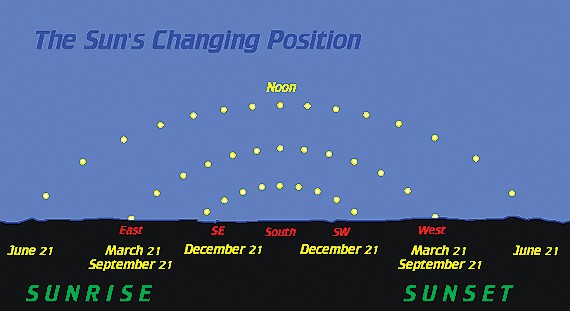
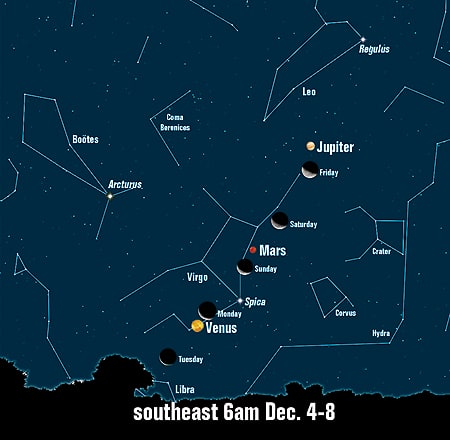
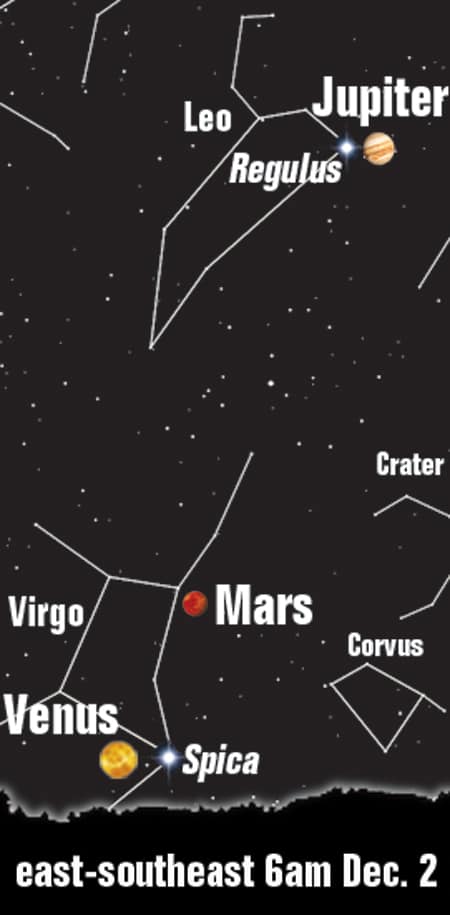
This week boasts the earliest sunrises of the year, when old Sol crests the horizon at 5:41am. We’re still a couple weeks from solstice, the overall longest day of the year, and the latest sunset won’t come for another two weeks after that. Why? Several reasons, including earth’s not-quite-spherical shape, its elliptical orbit around the sun and the varying point of high noon across the globe.     If you’re up before dawn, look to the northeast for the...

You’ll have to explore Canes Venatici

As evening twilight gives way to darkness, the first star to appear is likely no star at all but rather Venus, so bright you may be able to spot it in the west-northwest before sunset. By the time the sun does set, there should be no mistaking Venus, although the evening star does have company.     While last week Mercury and Jupiter pirouetted in tight formation around Venus at sunset, the three are equally spaced in a line through this weekend. Mercury is roughly four degrees...

Mercury, Venus and Jupiter gather in the glow of twilight

As the sun sets, Jupiter, Venus and Mercury emerge in its wake. These three planets will spend the coming week in one another’s company, playing a celestial game of leap-frog low in the west-northwest after sunset.     While these planets appear just a few degrees from one another, they are actually hundreds of thousands of miles apart. All the planets, earth included, travel along the same plane — called the ecliptic — as they orbit the sun. Every so often two...

Venus, Jupiter and Mercury are aligning in the west

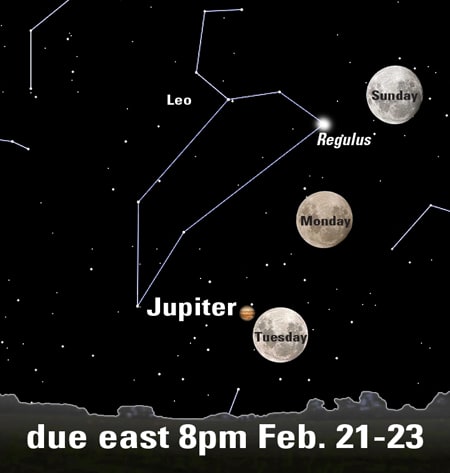
The moon is at first-quarter Thursday the 16th, when it appears high in the southwest at sunset and sets around 1am. Over the next week it shifts roughly 10 degrees to the east at sunset each night, until on the 23rd, the night of full moon, it rises as the sun sets and sets the next morning as the sun rises.     Along the way Luna makes some notable pairings. Saturday night you’ll find it trailing less than five degrees behind first-magnitude Regulus, the heart of Leo the...

Can you find Corona Borealis?

Thursday’s new moon is hidden amid the glare of the sun, but it reemerges Friday as a most slender, young crescent that you just might be able to see. You’ll need clear skies, an unobstructed view to the west-northwest and spot-on timing, as this moon appears low against the horizon for 15 minutes at most immediately following sunset. Brilliant Venus is just two degrees away, but you may need binoculars to pick out either from deep within the glare of twilight.    ...

The Eta Aquarid meteor shower returns

The moon wanes through morning skies this week, reaching last quarter Thursday, May 2, when it shines between the faint constellations Capricornus and Aquarius and is high in the south by dawn.     The sun sets this week around 8pm, revealing Jupiter high in the west, brighter than any star. However, if you have a clear view of the west-northwest horizon just after sunset, you may find the only brighter star-like object to the lower right of Jupiter: Venus, which is slowly...

Can you notice the Seeliger Effect?

Thursday marks April’s full moon, also called the Pink Moon for the early blooming phlox, the Grass Moon for the return of verdant lawns and the Fish Moon, hereabouts commemorating the opening of rockfish season. That evening, the moon rises in the east as the sun sets in the west. In parts of Africa, the Middle East, Australia and Asia, Earth’s shadow will partially eclipse the moon. The rest of us will have to be content with the golden glow of Saturn above the moon and to its...

The waxing moon makes predawn skies your best bet for this annual meteor shower

The moon is at first-quarter phase Thursday the 18th. Even with only half its face illuminated, the moon washes out the stars of amid the constellation Cancer the crab, in which it rests that night. But if you look beyond the moon, you will see that it is juxtaposed between a triangle of three more or less equally bright stars: Procyon to the west, Regulus to the east and Pollux to the north.     Friday evening the moon is to the right of Regulus, and by Saturday it is just a...

Luna pairs with Jupiter and glows with Earth’s light

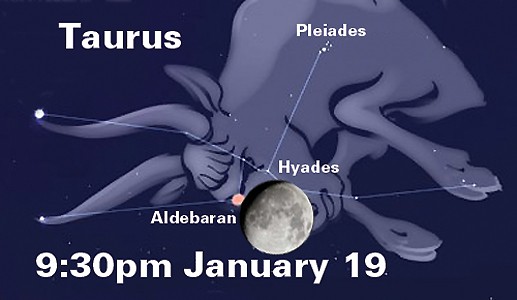
A nascent crescent moon emerges from the lingering glow of sunset at week’s end and then appears roughly 10 degrees higher and remains visible a half-hour longer night by night. Saturday evening, the moon forms a near perfect triangle with blazing Jupiter to the east and orange Aldebaran to the south, each less than 10 degrees from the other.     Sunday the moon pulls within two degrees of Jupiter, and the pair remain visible until 10:30pm. Even just a few days old, the...
Syndicate content